Throughout this pandemic, epidemiologists and public health officials have treated the words and concept of “herd immunity” as though it is the third rail of public health. Touch it and you’re a goner – career and reputation – gone. The only time herd immunity has even been broached is as a goal that experts are definitely not trying achieve. Even Nils Tegnell, the Swedish epidemiologist, and the idiot Trump brought on board, Scott Atlas, both of whose espoused policies were directly aimed at achieving herd immunity, denied repeatedly that herd immunity was their goal (and the cock crowed three times). Why? Simply because to achieve herd immunity with this virus a lot of people have to suffer and die, so herd immunity without a vaccine is never a responsible public health goal.
Well, listen carefully – herd immunity, herd immunity, herd immunity. There I’ve said it and I’m still here. I believe that certain states, cities, counties, and geographical areas in the US have achieved a qualified herd immunity and will not see any additional, significant spikes or waves of cases. My interpretation of the available data support this finding and, in fact, is the only logical interpretation of trends in some of the epidemiology curves.
First, what do we mean by herd immunity? Simply put, herd immunity is achieved when an infectious disease no longer has sufficient available host population that it can infect and use to reproduce. The virus runs out of hosts and begins to recede and, if the host population is lucky, the virus eventually dies out. Normally, the percentage of hosts that need to have resistance to the virus to achieve herd immunity is somewhere around 60%-80%. However, and this is important, even before reaching those percentages, as the proportion of “resistant” people grows in a population, the virus has more-and-more difficulty finding a susceptible host. Just think about that for a second and it will make perfect sense to you. If I am a virus in a host and I am surrounded by 99 other susceptible hosts, I am going to infect to my little virus heart’s desire. If, though, 50 of those 99 possible hosts have resistance to me, more than half of my forays to infect and reproduce run into a brick wall and the chance of me dying and not reproducing increases proportionally. I believe we are seeing those effects throughout the US right now and that certain areas have achieved some form of herd immunity.
In my opinion, North and South Dakota have achieved herd immunity. A fair estimate of the numbers support this assertion – probably 65%-70% of their population have already been infected with Covid and a certain percentage of their citizens (maybe 20%-30%) carefully practice the non-pharmaceutical interventions (self-quarantine, distancing, and masks) to protect themselves and will not likely alter these safety measures until they are fully vaccinated. Therefore, the Covid virus cannot find sufficient hosts in those areas to continue to reproduce and infect.
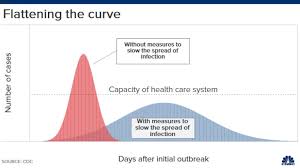
The epi curves for both North and South Dakota support this interpretation. Neither shows the gradual, slow decline that would be expected from interventions. Remember the curves from New York, New Jersey, and Pennsylvania last Spring – a rapid increase as the virus spread and gained a foothold, followed by a long, slow plateau and decline as the interventions slowed the spread and “flattened the curve”. Both the Dakota curves show the rapid decrease in reported cases that is classic in epidemiology when an infection has run its course. No “flattening the curve” here, just a precipitous plummet.
The reported Covid case numbers for the US as a whole show a similar trend, from an average of over 250,000 cases per day in mid-January to less than 100,000 cases per day one month later. Still high, but trending rapidly in the right direction. Just look at the epi curve for the US reported Covid case numbers. That’s not a “flattened curve”.
Now, I’m not saying that this welcome trend represents herd immunity for the entire country. My theory is that many of the areas of the country that were the main drivers of the national infection rate have achieved some level of herd immunity (LA county; areas in Northern California; large parts of New York City, Houston, Miami, and other urban areas; cities and counties near animal processing factories; other areas too numerous to mention). Those areas are no longer driving the country’s infection, hospitalization, and death rates and we are seeing the impact.
I also theorize that for the US as a whole, the virus is having greater difficulty finding susceptible hosts. The numbers strongly support this concept. Most experts and models set the true number of Covid cases at about 5 times the national reported numbers, meaning that approximately 140 million of US citizens have been infected and have some level of resistance to infection. Also, with over 500,000 deaths and a likely death rate from this virus at 0.4%-0.5%, the US death rate would support an overall Covid case number for the country at 100-120 million.
With a 330 million population, both above metrics support that about 1/3 of us have already been infected. Add to that number my conservative estimate that 1/3 of us consistently limit interactions (no bars, inside dining, churches, nor gyms), distance, and wear masks – essentially walling ourselves off from high infection risks. That means the virus is now facing the increasingly difficult task of finding susceptible hosts. The Covid virus now has to “bump” into approximately 3 times the number of people to find a new host as it did when the population was “virgin”. That’s the one thing that this virus doesn’t do well – it’s infectious, it can kill, it can mutate, but as yet, the virus cannot overcome a resistant population and we’re seeing the results of that in the national trends.
To summarize, my opinion is that we are on the verge of controlling this pandemic in this country. You can make the case that we have arrived here because of our country’s calloused disregard for the impacts of the pandemic, or sheer incompetence, or obdurate political stupidity and I will not argue. Nevertheless, here we are.
For the country as a whole, and certainly for the specific areas that I mentioned, I expect no 4th wave or significant spike of Covid infections. However, if the new strains gain predominance in our country and previous Covid infections offer no resistance to those strains, then all bets are off and we are in for a terrible time. Also, if, for some reason, the 30%-40% of us who have carefully protected ourselves throughout this pandemic would suddenly throw caution to the wind, run out of our houses, and start dancing unmasked in the street, then we will see a new spike. (God help us if that happens because most of those particular people are older and white and we really don’t want to see that population dancing. Really don’t.)
Finally, I am really unhappy with the public health officials explanations when asked by the perceptive members of the media why we are seeing such a drastic drop off in Covid cases. Those are some truly lame answers. One “expert” even tried, “as the winter season ends”. Really? Where in the US in early February as the number of cases drop rapidly is the winter season ending? All data need interpretation. If you are asking the American public to follow your advice, then you have to interpret the data wherever it leads or say “we don’t know”.
Best way to keep this virus on the run is get more and more people vaccinated. Then we’ll get back to some semblance of our lives and I can get back in the gym. So, really you people are keeping me out of the gym. Damn you all.
Stay safe, Stay informed. Wear the mask. Get the shot.
Of all the essays I’ve written on Covid (about 25,000 words), this was the most difficult. I’ve tried to succinctly put forth a controversial position on a complicated subject in an understandable manner. I’m not sure I’ve succeeded and I can certainly be criticized for the position, but, what the hell, I took a shot.
BTW, if I was still at CDC I wouldn’t be talking about herd immunity either. It has significant public health implications.
 Mike's Musings