Been a while since I’ve written about our old virus friend. Sometimes it just seems a bit overwhelming. There’s just so much coming out every day – science, politics, economics, human interest. Recently, though, there has been a great focus on Covid numbers as the basis for re-opening our society and as indicators for hope or despair, depending on your interpretation of the data. I’ve also received questions about certain indicators and what they mean. Given all of the emphasis recently about the various metrics, I thought it might be a good time to talk about some numbers and what they really may indicate.
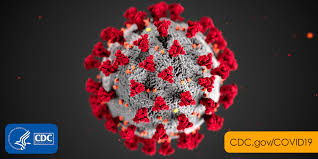
Before we get into all of that, let’s look once again at the little devil behind all of these riotous changes in our lives. The Covid virus is a tiny agent of destruction. It is submicroscopic. It is such a simple organism that a virus cannot even reproduce on its own. The virus needs to take genetic material from its host in order to replicate. You’ve seen the graphic representations of this particular virus – spherical with pointy spikes all over (pictured above) – not a particularly attractive fellow, but then I’m not a virus, so what do I know. This virus is far from a sentient being. It doesn’t think. It has no will. It cannot be dissuaded from its goal and it cannot be fooled by protestations of success from the White House or Fox News. It is a frighteningly simple thing in many ways. However, here is where it gets interesting, the only purpose of a virus is to replicate and it will try to do that with horrible efficiency inside a host. In Covid’s case, humans are the host and the virus’s replication causes far-flung damage to the host’s systems. So, simply put, the Covid’s purpose is to cause disease, death, and destruction to the human race. It will continue to wreak havoc until it is stopped by being unable to replicate, either in a host or in a population. That’s the enemy explained in one simple paragraph. That’s what we’re up against.
People tend to focus on the wrong numbers in the wrong way for the wrong reasons. Mostly, the media and the politicians quote two national numbers and, for a number of reasons, they are the most meaningless for determining next steps in closing down or opening up our society. Those numbers are also not useful for individuals to get a sense of their own risk of contracting this virus. Whether the confirmed case numbers for the US are going up or down has almost nothing to do with you or where you live. Still, they are the most cited and discussed.
Throughout my career, I followed what I thought was an epidemiological aphorism: “whenever you combine data, you lose information”. (However, I’ve never found another epidemiologist who had ever heard that statement, but they all agree that the underlying idea is valid. So, I’m going to say I made it up.) For a simple example of what that means, you can look at a single summary metric of bladder cancer incidence in the US. This number enables a researcher to see whether bladder cancer is rising, falling, or static, but unless you break it down by gender and race and risk factors you won’t see that the incidence in higher in men, higher in smokers, and highest in Black men. By breaking out the data, you are able to see the true impact of this disease in the subpopulations and design more effective interventions. A single number for bladder cancer incidence on a national level actually hides important information. The same is true of Covid metrics.
Covid Cases in US – Every single day since early March, this metric has been headline material. “Over 100,000”, “Over a half a million”, “Over a million cases of Covid-19 in the US”. In fact, this number is almost meaningless. We are currently claiming about 1.3 million cases. New York state has done fairly extensive antibody testing and found that almost 20% of the population in and around New York City are showing antibodies to Covid. With a denominator of about 10 million people, the antibody positivity for this area means that NYC alone has accounted for approximately 2 million cases of Covid since the outbreak began. The criteria for testing have, until recently, been so restrictive that many more symptomatic people were denied a test than ever actually received one. Add to that, the fact that 40-50% of Covid infections may be asymptomatic (and also never tested) and it becomes easy to see why the national case number is ridiculously low. My guess is that the US case number is anywhere from 8-12 times the official figure and we may have had 12-15 million cases. We won’t know until this outbreak is over and the data can be carefully investigated, but we do know that the current figure does not represent the US burden of Covid.
The other major difficulty with relying on the national number is that a running total of cases for the US population, even if accurate, is not helpful. Within no national plan for dealing with this crisis (and there is NO national plan), decisions on the implementation and relaxing of interventions have been left to state and local officials. Therefore, the important numbers are the state and local data on cases, hospitalizations, ICU admissions, and deaths, not national numbers.
COVID Deaths in US – This metric has many of the same limitations detailed above. Because of the way that deaths are counted in this country, there is a significant undercount in this national death statistic, though no one know exactly by how much. Certainly, the accuracy is not as poor as the national Covid case number, but the number of deaths are certainly higher than the current statistic is indicating. The mortality figure, both nationally and locally, becomes much more useful to health authorities and to the public when the data are presented as broken down by age, race, and income. If we want to save people, we need to know who is dying and where, not just how many.
Over the next 2 years, we are going to live and die with Covid data, both literally and figuratively. We need to understand their utility and limitations. Today, I talked about the 2 most often quoted and referenced national numbers. In my next post, I will cover a few more useful metrics that scientists will be interpreting and providing to elected officials and other decision-makers as we continue to navigate through these tumultuous times. I think you will hear more about these numbers from politicians and the media in the coming months, so we should talk about them.
Until then, stay healthy and find some peace of mind. The future is not totally bleak. Good things will come.
 Mike's Musings