This is the essay that’s been on my mind for over a week. Hanging back there. Demanding to be noticed. Refusing to be ignored. This is the essay that I did not want to write.
Everyone wants social distancing to end. Let’s go out. Watch games. Eat lunch. Look at our phones. Make money. After all, “this country wasn’t made to be shut down”. (What does that even mean? What country was “made to be shut down”? American exceptionalism again. Nonsensical.) Some on the right are even saying out loud that the older segment of our population should be willing to sacrifice their health, and even lives, to get our economy rolling. The Lt. Governor of Texas (71 years old?) said he’s more than happy to sacrifice himself for our GNP. I am, too. I have done some deep soul searching on this matter and I am certainly willing to sacrifice the Lt. Governor. I mean, how much of a loss could it represent, really?
Simply put, there is tremendous political and economic pressure to fold our tents on this social distancing and self-quarantine stuff at the first opportunity. You better believe that is exactly what will happen. At the first sign that the apex of the epidemiology curve has been reached, somewhere, anywhere, some leaders (guess who?) will declare victory and retreat from the front lines. The reality is that we are in for a long slog before we will see any sign of hope. Yes, New York will probably reach their highest hospitalization rate sometime around Easter, but Houston and Dallas will just be warming up and Chicago and Detroit will be in full scramble for beds, ventilators, and staff. That prospect does not even consider medium to small cities and rural areas. Each of these are horribly unprepared for what is inexorably heading their way. How does a county hospital with 15 ICU beds prepare for COVID and who will be left to help?
Sorry, the carnage that the waves of epi curves will represent is not even the subject of this essay. As a quick review for people who haven’t read my previous writings on this subject, public health authorities have a limited arsenal with which to battle a novel virus coursing through a population. The first, and most effective, “arrow in the quiver” is quick, reliable testing of the initial wave of cases with concomitant contact tracing and isolation. Primary prevention of people being infected. On that front, in this war, the US failed spectacularly (subject of a later essay). Once the virus invades the population on a wide front, prior to the development of a vaccine, society must rely basically on 2 approaches: isolation of known and suspected cases and implementing onerous measures of social distancing. This, of course, is where we are presently.
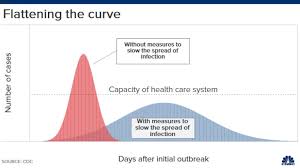
These measures, currently in place in many areas of the US and throughout the world, are designed to “flatten the curve” and prevent/limit our health care system being overwhelmed. If you look at the graphic at the top of this article, you’ll see a hump-like curve that does not peak at an extremely high level and then drop precipitously. That flattened epi curve still represents a frighteningly high case rate over an extended period of time. Social distancing measures may save our hospitals, but they will not break the back of this pandemic unless they are implemented with ruthless effectiveness like the Chinese government did in Wuhan. The Wuhan intervention was the “cone of silence” descending on an entire population. No one in. No one out. No one outside their homes. No one disobeying. No one going their own way. Eight weeks later, the epidemic was effectively over.
In contrast, the implementation of societal measures in the US to control COVID have been piecemeal and, probably, relatively ineffective. This patchwork approach, combined with vacillating Federal leadership, and a fairly infectious respiratory virus ensures that the US will have rolling peaks of epi curves in various geographical areas and populations for months to come.
Even given all of that good news that I just highlighted, there will come a time when the political powers and Fox news decide that enough is enough and we need to get back to work. (One Bozo thought that should happen by Easter because it is a “beautiful time”, particularly for our Muslim and Jewish citizens.) When that occurs, I guarantee that the virus that causes COVID will still be in our community and still be infecting people, just probably not at the same high levels. The essential question then becomes, “What will protect you, your parents, children, spouse, siblings, and friends? What will protect everyone you know and care about from COVID when social distancing is pulled off and before there is a vaccine?” Do you know because I sure don’t.
Viruses pinging their way through a large population are not predictable. That’s why the models vary so much in their projections. The COVID virus may weaken substantially, or may withdraw for a time and reappear in another season, or the virus may simply recede. A distinct possibility, however, it that the virus will remain in the world’s population causing illness and death for the foreseeable future.
At some point, fairly soon, the US is going to try to reclaim our previous lives. I do not see how that will work without serious damage to large numbers of our citizens. Any idea that you can re-start this economy “section by section” of this country is ridiculous. Also, the preposterous idea that the work force can begin to be composed of people who have already survived the virus and are now immune and that this group will re-start the economy is inane. Remember in grade school, to encourage participation, the teacher would say, “there are no bad ideas”? Well, there really are.
Here’s one. I heard a talking head on tv the other night saying that eventually a high enough proportion of Americans might have survived the infection and the virus will not be able to find sufficient susceptible hosts and then die out. This seems to be an idea that may be related to the concept of “herd immunity”, usually applied to evaluation of vaccine effectiveness. In my opinion, for the US to achieve an effective level of “herd immunity” for a virus like this, we would need to have about 66% of the population infected and recovered. In a country of 330 million, that works out to 220 million infections of whom 20% (44 million) would require hospitalization and approximately 1% (2.2 million) would not survive. This is someone’s idea of a plan? See, there truly are bad ideas, now go to the back of the room.
Listen, I don’t know exactly what will happen. No one truly does. We’ve never been here before. I look at the data that I can see and sift through the possible options and scenarios with a “trained brain” and I sure don’t like what I see. I decided a while ago to share what I know with whomever wishes to read my writings. I try to make it clear when I am sharing facts and when I am giving my opinion. For now, I am going to continue to share my viewpoint even when it is this bleak. And this is bleak, right now.
My opinions:
Is COVID still a reason for worry? Certainly
Will these measures be effective in saving our health care system? Partially and regionally
Are we prepared? No, not even close. That’s why all the people briefing you look so worried.
How many will be infected in the US? Millions to tens of millions
How many will die? What a terrible outcome to try to project. I would say somewhere between 100,000 and 500,000 (unless we run out of supplies and staff).
We will come out of the other end of this. It might be a little while, but we will. I don’t know that we will be stronger or smarter. I actually don’t think so. We were supposed to be smarter after 9-11 and what happened in the last election? So, I’m not necessarily sanguine about the smarter part, but we will survive. The future will once again include joy, happiness, big games, small weddings, classrooms, friends, touching, hugging, and all the things that humans crave as social animals. I can guarantee that much more than anything else that I’ve written today. So, be smart, pay attention, and stay safe.
 Mike's Musings
Excellent and sobering.
LikeLike