I haven’t written about climate change in a good, long while. Actually, I haven’t written anything in quite some time. I think, mostly, I’ve been absent because I find it very hard to write about politics or the environment during the present administration. Christ, the whole thing is just so depressing. I mistakenly thought that having Trump as President would galvanize my positions, as well as those of other progressives, but it turns out that he’s just worn us down. His hate, racism , divisiveness, and overall idiocy is indefatigable, whereas it appears that we unfortunately are not.
Anyway, let’s take a peek at our climate and its global impacts and see if renewing the US emphasis on coal (the world’s dirtiest source of energy) has solved our problems. Last year was the hottest year on record and this past June was the world’s hottest June ever recorded in 139 years of record-keeping. Oh my God, could it be that Trump and his flying monkeys have no idea what they’re talking about?
European Heat Wave: During the final week of this past June, Europe baked. One town in south France, Gallargues-le-Montueux, reached 115 degrees F, the hottest temperature ever recorded in France. In Germany, speed limits were imposed on parts of the Autobahn because the extreme heat was causing the roads to buckle. In Spain, wildfires destroyed 25,000 acres in 4 regions of the country during a 2 day span. Italy placed more than a dozen cities on red alert as temperatures were expected to top 100 degrees F for multiple, consecutive days. This 20019 heat wave that blanketed most of the continent followed a severe heat wave in Northern Europe in 2018 and the 2017 heat wave, nicknamed Lucifer, which devastated the Mediterranean. Climate attribution scientists estimate that Lucifer was made more than 10 times more likely because of climate change.
US Heat Wave: As I write this, two-thirds of the continental US is roasting under scorching heat. Heat watches and warnings have been posted from the Plains and the Midwest all the way to the Atlantic seaboard, including the Deep South. Heat indices above 105 are being felt in Chicago, St. Louis, Detroit, Philadelphia, Boston, Washington, Atlanta, Nashville, and hundreds of other cities. Perhaps more importantly from a public health perspective, nighttime will not provide the necessary relief. During this major heat wave, overnight temperatures will not drop below the upper 70’s to low 80’s. Over 55 million Americans are currently under either a heat watch or a heat warning. A new study by the Union of Concerned Scientists (full disclosure – I am a member of this group) projects that some cities that have experienced an average of one heat wave per summer season for the last century will suffer from 4 to 5 equally severe heat waves per summer by mid century.
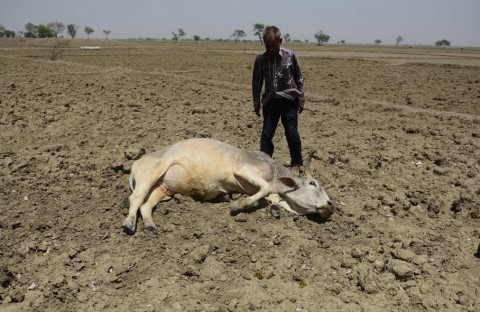
Indian Water Crisis: Let’s be blunt: the world’s second most populous country is running out of water. Approximately 100 million people are facing extremely dire circumstances in the next 1 to 5 years. 21 major cities in India may run out of groundwater in the next year. Much of India’s water crisis is directly related to an astounding growth in population combined with a paucity of urban planning and infrastructure improvements. However, as we will see in many instances over the next few decades, climate change is exacerbating these problems. Monsoon rain levels have been below historical averages for 6 of the last 7 years, at least partially because of our changing climate. Monsoons are the lifeblood of much of India’s agriculture and are critical as a source of drinking water. In addition, of course, India is a much hotter country than it was just as recently as at the turn of this century. Since the year 2000, India’s average temperature has increased from 24.6 degrees C to 26.3 degrees C in 2017 – a truly alarming spike.
What happens when a populous, urban area runs out of potable water? We don’t really know, but we’ve seen severe water shortages in refugee situations and it’s not pretty. Societal norms will break down. (Remember societal norms? We had them in the US before January, 2017. They’re good things to have.) Crime will increase. Costs will be out of control and those with power will seek to use it. As you can imagine, the current wealth divide will worsen and the poor will not fare well. We will witness these scenarios during the lifetimes of most of us.
By the way, for those of you thinking, “Poor India”, don’t. This particular problem is a lot closer to home than you may realize. A study by the World Resource Institute places the United States into the category of countries with an extremely high (>80%) likelihood of suffering from water scarcity by the year 2040. That’s 20 years away.
Now, how important is this next election? The House, the Senate, and the White House cannot continue to ignore the most important crisis the world has ever faced. For the last 100 years this country has feasted on cheap energy and, therefore, caused much of the problem of climate change. Now the US must not only join the other countries in finding and implementing climate change adaptations and remediations, the US must lead in this effort.
One thing is certain, we will all know when we fail.
 Mike's Musings