In early 1999, I was sitting in my office at CDC when the phone rang. On the other end were an EPA official and a Johns Hopkins professor requesting me to co-chair the Health Sector of the First US National Assessment on Climate Change. I agreed and, even considering the tremendous amount of work that my involvement in climate change added to my normal duties, I am so glad that I did. I knew, even then, the importance of climate change to our society and to the entire globe. What I didn’t know, and what no one was projecting 2 decades ago, was how rapidly these changes would begin to affect us or that we would see draconian impacts throughout the world only 15 years later. Still, the US fails to recognize the obvious or act with any alacrity.
There are really 2 areas that I want to cover in this essay. One, obviously, is to talk about the recent spate of hurricanes that have impacted this country in the last few weeks and the role of climate change in the genesis and intensity of those major storms. Before discussing Harvey and Irma, though, I’d like to just quickly discuss the language used in the public discourse on climate change over the last few years in the US.
There have now been 3 National Assessments of Climate Change in the US since Congress first passed a law requiring the Administration to report to Congress on the impacts of climate change on US society and citizenry. The National Assessment process basically convenes panels of imminent scientists to review peer-reviewed, published literature and determine what those studies indicate about climate change’s effects on the US. I played a role in each of those projects. My least involvement was as a lead author on the Second Assessment. For the First and Third, I was in a leadership position. So, I know whereof I speak (to speak in Old English).
It is difficult to convey the critical role of language in these reports. We spent days, literally days, to make certain that the words we used to reflect our level of confidence in our projections were accurate, informative, and uniform throughout the report. Limiting nuance was our goal. All projections were properly anchored in the available science and limitations of the data and the projections were clearly enunciated.
Contrast this cautious, conservative use of language on this critical subject with what is spewed by the climate change nay-sayers. In the public discourse on climate change in our current society, the difference in the use of facts and language will, unfortunately, always put the scientists at an extreme disadvantage. Stop and think about that for a minute – they are the only ones that know anything and, yet, they are losing the debate. An example: I switched the channel the other night to Bill Maher’s show and he was talking to some fool who was a vice president in the auto industry (?). The subject turned to climate change and this no-nothing said, “Every prediction that the scientists have made on climate change has been wrong. They said that the Florida Keys would be underwater by now. They’re still here, aren’t they.” Someone in the studio, at this point, should have stepped up and called him on his ignorance. Outed him as a fool and a liar. Pointed out that he had never read any of the reports and that he had absolutely no idea about what he was talking. No one did (Well, I did, but I was in my living room.). Neil deGrasse Tyson was there, but he had some lame retort and no one confronted this idiot. That’s the scientists’ debate on this issue in a nutshell. We’re too polite and, generally, not confrontational. Well, not all of us. But, we’re losing the debate and it’s costing all of us. (BTW, no one ever projected that the Keys would disappear by 2017. Not one scientific soul.)
ON TO THE HURRICANES
The 2 projections that virtually all climate change scientists have agreed on for 2-3 decades is that the earth is getting warmer and that warming leads to more heat waves and more extreme precipitation events. Earlier, there was some debate about what climate change might mean for hurricanes, but most of the recent data is clear that the rapidly warming oceans will provide more energy to increase the intensity of these storms and the warmer water and warmer air will permit greater absorption of water into the storms leading to heavier rainfall. So, those are the published projections for at least a decade. Let’s see what information Mother Nature provided:
- First time in history that 2 Class 4 or greater hurricanes struck the US in the same season.
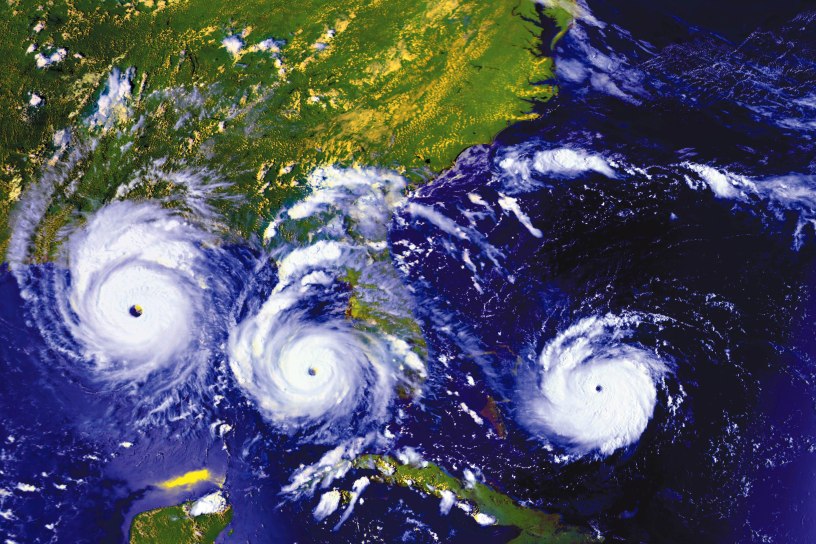
- First time in history that the Atlantic supported 3 Class 3 or greater hurricanes at the same time (see image above).
- Hurricane Irma sustained winds of 180 mph or greater for the longest time of any hurricane in history.
- Hurricane Harvey is the wettest hurricane on record in the Atlantic basin dropping more than 40 inches of rain on some locations.
- Hurricane Harvey dropped 275 trillion pounds of water on the Houston area decimating the country’s 4th largest city and actually pushing the earth’s crust down by 2 centimeters..
- Hurricane Irma forced the largest evacuation of people in history as approximately 3.5 million people were forced out of the state of Florida.
- At the same time, floods in 3 of Pakistan’s major cities caused massive devastation and death.
- Overall, floods in South Asia, particularly Bangladesh, killed over a thousand people during the same time period as Harvey and Irma.
- Combined, Hurricanes Harvey and Irma will cost this country over $100 billion.
- At one point, more than 3/4ths of Bangladesh was under water.
There will be careful scientific review of these events to attempt to appropriate what proportion of Harvey and Irma and the South Asia flooding can be attributed to climate change and what proportion to the vagaries of weather. This will take a while and when the review is completed you can expect a carefully worded, scientifically sound treatise published. Meanwhile, the Chief Tweetster will be spreading his foolishness and he won’t be alone. Who do you think will win the hearts and minds of the American public?
 Mike's Musings