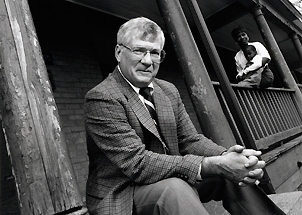
Dr. Herbert Needleman died last month at the age of 89. You’ve probably never heard of Dr. Needleman and that’s really too bad. Dr. Needleman was an American hero. A hero unknown to most Americans, but a hero nonetheless.
Dr. Needleman was a pediatrician, public health researcher, and child psychiatrist. A professor at the University of Pittsburgh, he was the primary researcher responsible for removing lead from gasoline and lead. Against seemingly insurmountable odds, Dr. Needleman (and others, of course) took on 2 of the largest industries in the US and won an incredibly important victory for public health and for our society.
In his groundbreaking research, Dr. Needleman showed that the impact of lead exposure on young children impacts them throughout their lives. Up until that time, lead was considered a short-term poison (primarily occupational) whose victims would suffer no long-term consequences after treatment to remove the poison from their blood.
Through a series of innovative, quality research studies (utilizing both prospective and retrospective cohort designs with various exposure and outcome metrics), Dr. Needleman showed not only that children suffer much greater impacts from lead exposure, but also that these impacts last through adulthood and alter the victims lives and place in society. When his findings were first published, Dr. Needleman was vilified and his professional reputation sullied. You see, lead was an important gasoline additive that prevented your car’s engine from knocking and lead added luster and durability to paint. Every house and apartment was covered in lead, so the real estate industry was also an interested party. Lead was also found in batteries and radiators and, really, everywhere. In the 1950’s and 1960’s, lead was more popular than Bob Hope. Truly, a ubiquitous product. Most importantly, lead was cheap.
Dr. Needleman’s findings would put all of these industries in jeopardy and they weren’t going to go quietly. The opposition was nasty. Industry hired mercenary “scientists” and wrote letters to the journals and to the University of Pittsburgh questioning Dr. Needleman’s methods and scientific integrity. The University of Pittsburgh caved. They not only convened a board of inquiry into the integrity of one of their scientists, but they locked Dr. Needleman’s office and files. In preparing his defense, he was only allowed into his office and file cabinets in the presence of an employee of the University’s ethics office. He was at the nadir of any scientist’s career, but he knew that his methods and findings were correct and arrived at honestly. The University and Dr. Needleman’s accusers wanted the hearing to be “closed door” and he would be limited to himself and an attorney for representation. Dr. Needleman insisted that the meeting must be open to all interested parties, including other researchers, and to the press. In his own words, “that was a long fight” but the University finally acquiesced and the hearing would be open. None of his accusers showed up and, of course, his findings were totally validated. Dr. Needleman was vindicated and continued researching and fighting for children and environmental health for the rest of his life.
Lead exposure in children impacts the developing brain and central nervous system, impairs cognitive development, reduces IQ, reduces attention span, reduces education attainment, and significantly increases anti-social behavior. Lead also affects other organ systems and is associated with anemia, hypertension, and kidney disease. In short, lead is a bad actor.
I’ve often wondered what our society would look like had lead remained in gasoline and at 50% levels in paint. Without a doubt, we would have much more crime, particularly adolescent crime. We would have a greater proportion of our population operating on the “intelligence fringe”, unable to learn or keep employment in anything but the most menial jobs. Medical utilization and costs would be higher. Most importantly, our entire population would be “dumbed down” by maybe 5 to 10 IQ points. For example, if not for Herbert Needleman and a few others, millennials would still be constantly looking at their phones, but the phones wouldn’t be turned on. That’d be bad. I think.
Dr. Needleman was about 3 decades my senior, so we didn’t have much interaction. I was in one meeting with him and he and I had a long phone call one time about a CDC policy on lead. He still influenced me. He was intelligent, thoughtful, and kind. What a wonderful combination in a human being. He was a teacher for his entire life and, although revered in his field, he was humble.
Herbert Needleman died last month. He was a giant. You all benefited from him. Those of us in environmental health benefited most of all. I am sorry he died, but I am so grateful that he lived.
 Mike's Musings