For some reason, I have resisted writing about the Flint water crisis. I’m not sure why. During my career at CDC, I ran the Division that conducted all of CDC’s environmental health studies and, for some of that time, oversaw the Childhood Lead Branch. This subject is right in my hitting zone, but I haven’t written this essay up until now. I think the main reason was that I wasn’t sure I could do the subject justice in less than a thousand words. I’ll cover what I can and you can judge whether it helps your understanding of this important sequence of events in this country.
First, a quick word about lead. Lead is a toxin that impacts the human body in a number of ways. Most importantly, lead finds its way into, and impacts, our central nervous system. This is particularly important for children for 2 reasons: children absorb much more lead through the skin and digestive system than do adults and children’s brain development is demonstrably impacted by lead. So, children get more lead and lead impacts them more than adults. Now the good news. Lead levels are much lower in the environment and in children than anytime in history. Because of health and enforcement agencies’ research, lead was removed from gasoline entirely in the mid- 1970’s and from paint immediately thereafter. Because of these bans, blood lead levels of concern as defined by CDC fell steadily over the last few decades from 50 micrograms per deciliter (ug/dl) to 25, then to 10, and now to 5. When I was young, my lead level was probably in the 20 ug/dl to 30 ug/dl range. Just think what I might have accomplished had I been lead free? You too, maybe. Well, more me than you, probably, but anyway back to the issue.
Essentially what occurred in Flint was a combination of factors that led to a complex series of events resulting in a large poor, black community being exposed to a significant neurotoxin (lead) in their drinking water. That’s all. Move along – no story here.
Michigan’s Governor, Rick Snyder, ran his campaign on the simple principle that he was a successful businessman who could fix the state’s problems with good business practices. (Now, where have I . . Oh, never mind). After instituting large tax cuts, Snyder used an imaginative interpretation of a state law to install “Emergency Managers” in Detroit and Flint. These un-elected managers had “overseer” roles in policy and management decisions. In other words, they made the decisions for these cities while the people elected by the (primarily black) citizens of these cities were sidelined.
Flint’s Emergency Manager decided to save “millions of dollars” by discontinuing the contract through which Flint purchased drinking water from the Detroit system. The plan was that Flint would pipe their source water in from Lake Huron and save money. The problem was that the pipeline wouldn’t be ready for years and Detroit cut off their water supply to Flint. The Emergency Manager made the decision to use the Flint River as the source water for the city. This was not a good idea. Not just in hindsight, either. Many experts at the time said the the Flint River would not meet the criteria for a water source for a city’s drinking water system. (As a quick aside, water people have known for decades that the quality of finished drinking water is more reliant on the quality of the source than any other factor. All the treatment processes can only do so much to improve water quality. Flint River as a source was never going to make the grade.)
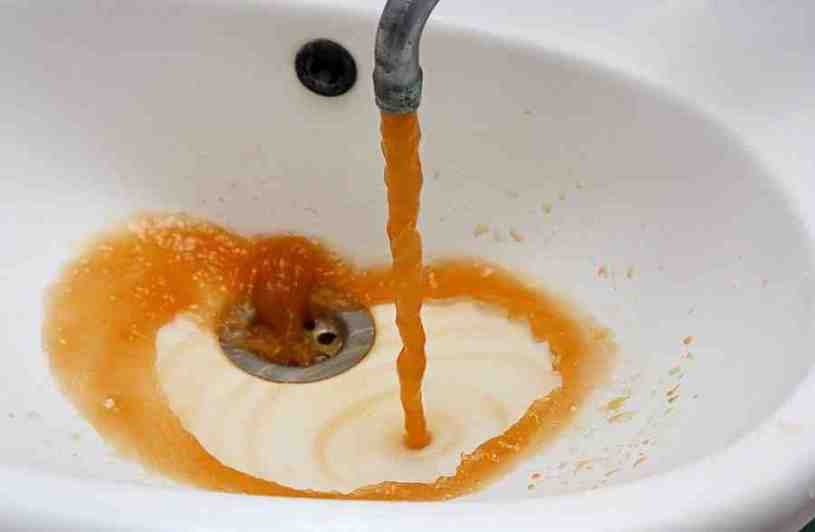
After the switch was completed, Flint’s water was awful. The water was brown (pictured above). It smelled. But it did pass the EPA’s water regulations, for the most part. So, officials told the public that it was fine. One official even said that people were wasting their money buying bottled water to drink. What almost no one knew was the the pH of the water was such that it was leaching the lead from the old pipes that make up Flint’s (and almost all other cities) water distribution system. So that water that passed tests for lead at the testing sites ended up at some alarming levels by the time it reached the people’s home taps.
Where are we so far? A know-it-all Republican governor usurps the election choices of major cities by appointing managers. A manager, who knows nothing about running a city or about drinking water, makes a sweeping decision to alter the drinking water source for a city, leading to high levels of a known neurotoxin to show up in people’s homes. Good so far?
Meanwhile, at EPA Regional Office in Chicago, a Federal official is warning the Michigan Dept. of Environmental Quality that they should add anti-corrosive measures to the source water because the pH may be leaching lead from the distribution pipes. Not only is this prescient scientist ignored, but the EPA Regional Administrator apologizes to Michigan for his warning. Seems that what he sent was just a “draft”. Michigan DEQ does nothing and the EPA Region does nothing. This is where the story really went south for me. I spent 33 years in public health and worked closely with EPA and many state environmental agencies on countless issues like this. I know that people can make mistakes. Numbers can be missed just because of the sheer volume of numbers that you review and the plates that you have juggling at any given time. But to ignore a logical, scientifically sound warning that comes from a person that knows the field is beyond my imagination. Everyone knows about lead being leached from old pipes. Everyone. It is common knowledge and all water and environmental health people are very aware of the danger. In my mind, it would be virtually impossible for state agencies to receive that warning and not immediately move to test and remediate. Yet, that’s exactly what they did – nothing.
To move the story along, a local pediatrician and a number of activists took the lead for testing the children and the taps and, after being ignored by DEQ and the state health agency for some time, finally attracted the attention of the press. Thank God for “Fake News”. Events moved quickly after that and Flint became a national story. Bottled water was offered; tap filters were installed; the water source was switched back to Detroit; and lawsuits were filed, both criminal and civil.
Children in Flint were impacted by this cluster****. A number of studies have been conducted on the children and all show an increase in lead in the children’s blood after the water switch. CDC’s surveillance data shows that the percentage of children in Flint above the level of 5 ug/dl went from 3.1% before the water debacle to 5% after. The percentages between 5 ug/dl and 10 ug/dl went from 2.5% to 4.2%. Luckily, there were very few children tested that were above 10 either before or after the water switch. That’s bad and it should never have happened, but compare those levels to the national median of 13.7 ug/dl of lead in blood in all children for 1976. More than 50% of all children in 1976 were well above the highest levels that are being found in Flint surveillance data.
At least 3 state employees of the DEQ have been convicted in the Flint water case and sentenced to prison terms (though not for lead, for Legionnaires Disease) and the criminal investigation continues to move forward. The EPA Regional Administrator resigned. Other EPA employees have been demoted, as have employees at the Michigan Department of Health and Human Services. The Emergency Managers are gone in both Detroit and Flint.The Governor continues in his office. Of course, he does.
Here’s the crux of the matter to me: Government has a critical role to play in our lives and when government fails, the ramifications are often cataclysmic. Reagan portrayed government as the enemy of the people and, to some extent, all Republican candidates for all levels of office have continued that theme to this day. That is a dangerous, myopic mindset and essentially caused this crisis. Without a doubt, there are others coming.
 Mike's Musings