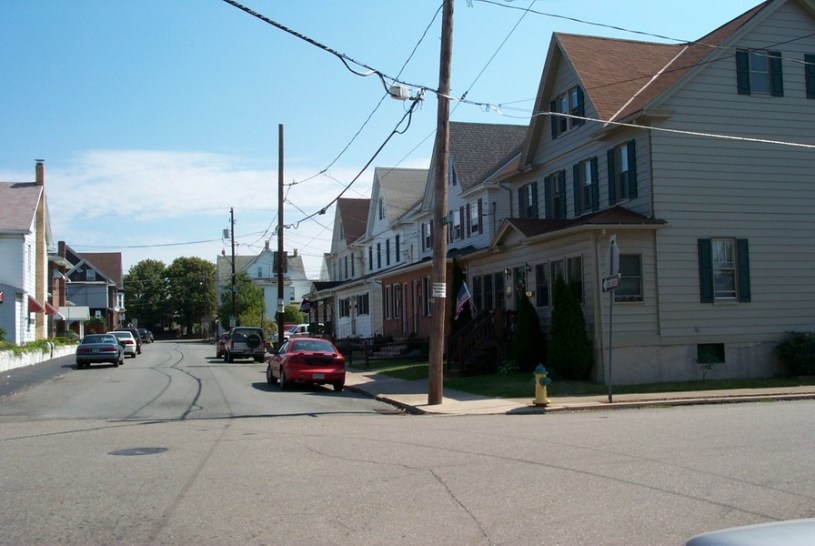
Opie had nothing on me. Seriously. My bike and I – we had free rein. Slide your glove over the handlebars and head to a field. Wedge your ball in the frame and you were set for an afternoon of ball at AD Thomas or DA Harmon. Meet up with Billy Curilla or Jimmy Lundy and go anywhere. Anywhere. There was no worry. No fear. You were in Hazleton. You were safe and people knew you and knew your parents (that last part could work against you).
The major influences in my life follow the typical list: parents, siblings, friends, teachers, and church. For me, though, a major driver in how I ended up, for better or worse, was the town in which I grew up. There was a freedom and sense of security that I felt in that little city, without realizing it, that has been important to me for the rest of my life. Invaluable.
All American City
Hazleton was (and for the most part still is) a small city of about 30,000 people in the mountains of northeastern Pennsylvania. The Hazleton that I remember seemed to be composed mostly of churches and bars. There were Catholic churches everywhere and for every congregation – Italian churches, Lithuanian churches, Polish churches, and one big Irish church, St. Gabriels. My church. As many churches as there were, the bars far outnumbered them. Every neighborhood and most corners. Not sure if that the confluence of churches and bars tells you everything about my town back then, but I think it gives a fair representation. I’m sure there was the entire panoply of social ills that comes with that many bars, but not in my house. There was poverty, but we were all poor. So, who knew? It was ok.
Back in the ’60s, Hazleton was awarded an “All American City” designation. Ten of these awards are given out each year by the National Civic League to recognize communities that work together “to tackle challenges and achieve uncommon results”. Somehow Hazleton won even with a pretty crooked government. I remember that when you applied for a summer city job, you were told to print your family’s party affiliation across the top of the form. Totally illegal. I knew that anyone printing “Republican” would have loads of free time over the summer.
Overall, Hazleton worked pretty well. The schools were good; plenty of playgrounds; the downtown was alive; and, for a number of years, the best summer activity and recreation program for the playgrounds that a kid could imagine. My view of Hazleton was short, innocent, and biased, but it felt good growing up there.
Troubled Times
“Hazleton Man Busted for Selling Heroin”
“Polano Gets Life for Hazleton Homicide”
“Cash, Guns Seized in Hazleton Drug Bust”
“Deadly Drug Overdoes Investigation in Hazleton”
“Rash of Overdoses Hits Hazleton Hard”
My old town is in trouble. The news headlines above are just a sample of reports over the last 6 months. Hazleton has a critical heroin and opiate drug problem and, if the town cannot get healthy somehow, the problem could be fatal.
A few years ago, I went back to Hazleton for my father’s funeral. My sister and brother-in-law still live there and still love the town. I took my rental and drove to all of my old haunts. I was crushed. Alter Street, a neighborhood that I knew so well, my whole family knew so well, is now mostly dilapidated – filled with drug houses and shooting galleries. The house I grew up in, and my father grew up in, is ramshackle. There was an hole in an upstairs window. Paint peeling. Porch and fence falling apart. None of the playgrounds that I remember so fondly are even functioning. There is a crime and drug induced pall hanging over my old town.
The situation would be sad enough if the recent fate of Hazleton was unique. Unfortunately, the story is found across the country in towns and cities that have weathered the loss of manufacturing plants and jobs along with the hope and self worth that accompanies gainful employment and future possibilities. In a way, Hazleton is still an All American City.
Ironically, one factor may have impacted Hazleton even more that some of these other places was, at one time, a source of pride and hope for the city. When the US interstate highway system was complete, Hazleton found itself at the crossroads of 2 of the most important highways in the country – US-80 and US-81. Hazleton billed itself as the “Crossroads of the 80s” and expected the newly planned Valmont Industrial Park to be a thriving manufacturing and distribution center for decades to come. For awhile, the plan worked. Small plants did locate in Hazleton and take advantage of the transportation access, but soon these jobs relocated overseas and the plants closed depleting Hazleton’s base.
The access to the interstates was still very attractive to one important manufacturing/distribution industry – the drug trade. Heroin addiction is an increasing problem in the US, particularly among middle aged whites. Drug-related deaths, primarily from heroin and prescription opiates, are responsible for the surprising increase in death rates among this group nationwide. Small and medium sized communities are also adversely impacted. Drug overdoses and violent crimes are soaring in many of these locales in the south, midwest, and northeast. The drug comes in through Mexico and invades the US along the interstates. Heroin is tearing apart small towns from Iowa and Nebraska to Vermont and Maine. You can trace I-25 going north and identify dozens of towns impacted by this epidemic. The evidence is just as strong along I-35 in Kansas and Oklahoma.
Hazleton would be viewed by traffickers as perfect for heroin sales and distribution for points up through the northeast. With 2 major highways, high unemployment, recent difficulties with an upsurge in immigration, and a police force of 35 officers for 30,000 people, Hazleton was ripe for the taking. They took it. We need to take it back.
The Future
It is beyond my expertise and the scope of this essay to offer solutions for the heroin and opiate epidemic plaguing the smaller cities and towns of this country. Obviously, a multi-pronged approach involving enforcement and assistance for effective treatment will be needed. I’m afraid major social engineering is going to be required in this country to answer the underlying problem of large swaths of our population being left behind by globalization, technological advancement, and the concentration of wealth. I haven’t seen that we have the stomach for that type of fundamental change, yet.
I think Hazleton can come back. It will take awhile, but perhaps the diversity that caused such upheaval in the town can kindle a rebirth in the area. Hazleton has survived difficult times before, but I don’t know how much time there is left.
As I mentioned earlier, growing up in Hazleton seemed to me a significant factor in determining the adult I became. It was hugely important. I can’t help but think how growing up in the misery of Alter Street right now may be affecting some little boy in a totally different way.
 Mike's Musings